
Public prototype · Your circuit lab online
From the first wire
to the aha moment.
Draw circuit diagrams, simulate waveforms, lay out PCBs and document your design. Meet OhmNest, your online electronics workbench.
Try it without an account. Nothing to install.
Launch offer · Register now for a full year of Lab access. No payment details.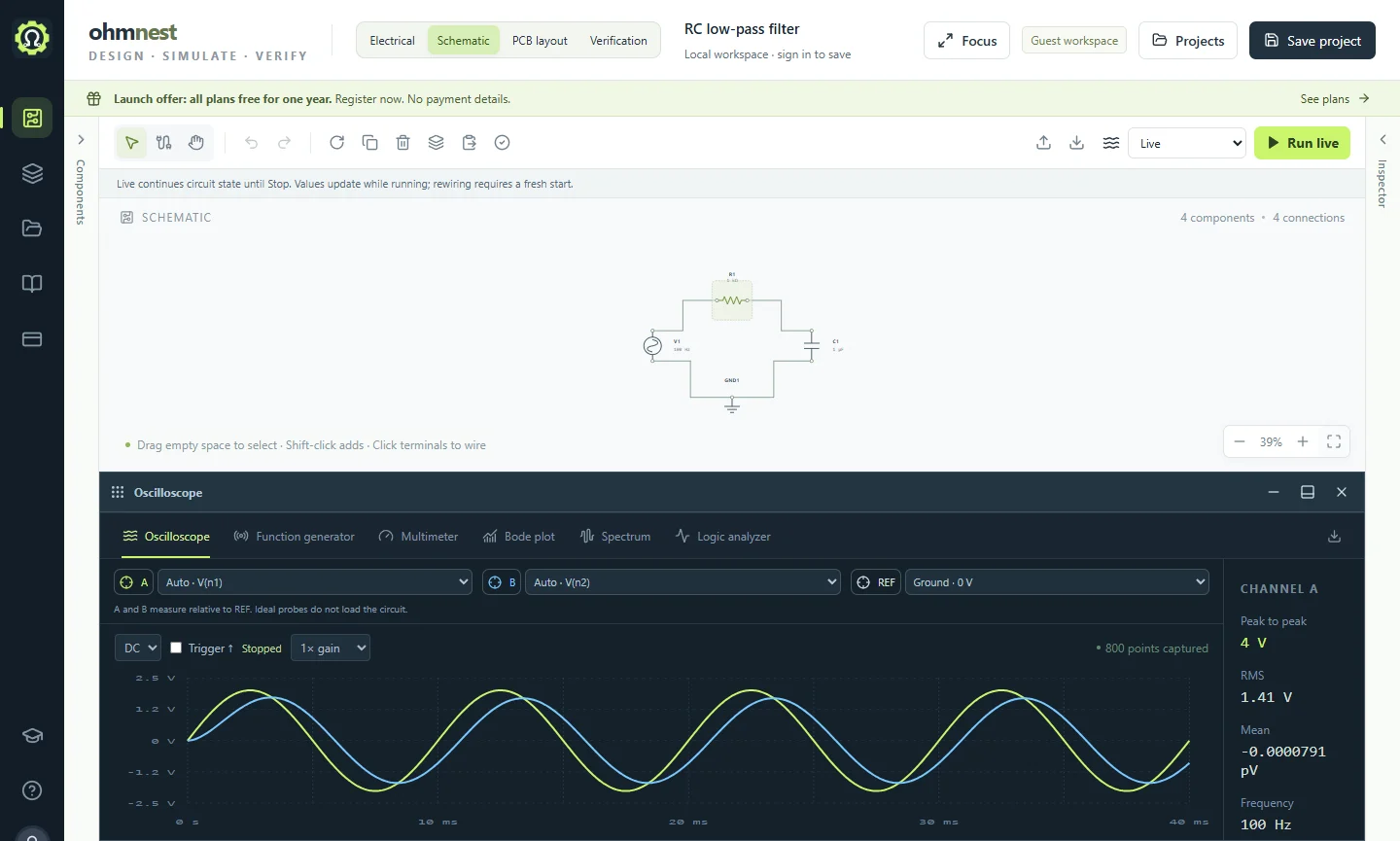
A connected workflow
More than a drawing.
Move from a circuit idea to measurements, a board and project documentation, in one browser application.
Draw a circuit
Draw electronic circuit diagrams online. Place components, connect terminals, label nets and keep editable OhmNest projects.
02 / SimulationSimulate and measure
Simulate circuits online with transient, DC and AC analysis. Explore waveforms using an oscilloscope, function generator, multimeter and Bode plot.
03 / PCB layoutLay out a PCB
Move from an electronic schematic to PCB layout in OhmNest. Place footprints, route tracks, inspect design rules and export manufacturing files.
04 / ElectricalDocument the design
Create electrical drawings and documentation in OhmNest. Organize sheets, devices, terminals and wires, then produce project reports and drawing exports.
Start with something that works
Change one value.
Learn something new.
Why does a filter reduce a high-frequency signal? What sets a timer's frequency or an amplifier's gain? Open a working example, change a value and compare the result.
Browse all example circuits →RC low-pass filter
A 1 kΩ / 1 µF filter. Compare the input and output; sweep AC to find the 159 Hz corner.
Timers555 astable oscillator
A complete 555 oscillator with timing resistors, timing and control capacitors, reset wiring and an output load. Approximately 48 Hz.
AmplifiersNon-inverting amplifier · gain check
A ±12 V behavioral amplifier, 100 mV input and 90 kΩ / 10 kΩ feedback. Run all four 1% resistor corners and verify 0.97–1.03 V output. This model has no physical bandwidth or noise model.
Learn by building
Your first circuit is a few steps away.
Readable guides with expected measurements, troubleshooting notes and an interactive companion inside the workbench.
Build your first circuit
Draw a voltage divider from a blank sheet, wire its terminals and measure 2.5 V.
8 min tutorialUse the scope and function generator
Compare two signals, change a source and read time-domain measurements.
5 min tutorialRun a circuit live
Keep a circuit running while you adjust the generator and component values.
Make room for your next idea.
A free account will always be available. During the launch, new verified accounts get one full year of our largest plan.
Create your free account →Compare the plans